Part 3: Understanding Your Goals Before Designing And Implementing Software
Learn why understanding organizational goals and product vision is essential before jumping into technical solutions, and discover practical tools to clarify objectives.
In the previous articles, we explored stakeholder interviews and the architect’s toolbox. Now, let’s focus on one of the most critical aspects of software architecture: understanding what you’re trying to achieve before designing solutions.
Too often, teams jump straight into technical discussions without fully understanding the organizational objectives. This leads to:
Solutions looking for problems
Misaligned technical investments
Wasted effort on features that don’t deliver value
Architecture that doesn’t support business growth
Worst-case scenario: Goals? What?
Sometimes you’ll find yourself in an organization where goals are:
Unclear or vaguely defined
Conflicting between departments
Not communicated effectively
Changing frequently without clear reasoning
In these situations, you need to help the organization define its objectives. Consider using frameworks like:
North Star Metrics - A single metric that captures the core value you deliver to customers
OKRs (Objectives and Key Results) - Clear objectives with measurable outcomes
Business Model Canvas - Understanding how the organization creates and delivers value
Remember: without clear goals, any technical solution is just a guess at what might be valuable.
Challenging scenario: Goals are clear, but Product Vision isn’t
In this case, your organization has set clear and measurable objectives, but there is no clear path to how to make that possible from a product perspective:
What is the conceptual solution, your offering, that will help achieve those goals?
What are your users, customers, or actors in general that will interact with what you offer to produce the value that you defined in your goals?
What are those interactions? What do they need, and what do they cause?
You need to follow a similar approach as for the first case. You can ask your stakeholders, e.g., Product Teams or Product Designers, to explicitly describe the Product Vision and map it to the organization’s goals. Ideally, the result should be a document, presentation, or visual—something you can use later as input to design the architecture.
Again, there are many frameworks for determining the product vision, such as User-Centered Design, Story Mapping, and Value Proposition Design. You can participate in the process if needed, but someone else should drive the exercise to build a Product Vision consistent with the organization’s goals.
Introducing the Tool Cards: Exploring Our Goals
Let’s look at the first Tool Card from the Software Architecture Toolbox.
“Exploring Our Goals” summarizes how to reach one of the most critical inputs needed to build proper software architecture: the Organization’s goals. You may not need this card if you have clearly defined objectives.
Exploring our Goals
Tool Card: Exploring Our Goals
Purpose: Understand and document organizational objectives
Format: Workshop or series of interviews
Frameworks to Consider:
OKRs (Objectives and Key Results)
North Star Framework
Balanced Scorecard
SMART Goals
Prerequisites:
Access to leadership team
Understanding of market context
Historical performance data
Outputs:
Documented organizational goals
Success metrics
Priority areas
Time horizons
I’ll use the same format for all the tools in the Architect’s Toolbox: a card with fields to describe the tool, preferred format, frameworks, and preparation needed. Each card shows prerequisites and outputs.
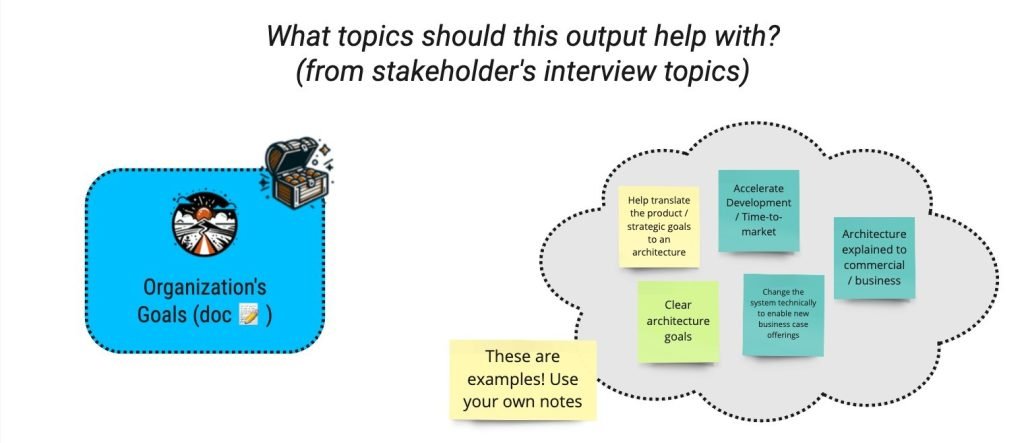
Next to each card, you should link the topics from interviews that will be clarified by using this tool:
Mapping stakeholder interview topics to the tool outputs
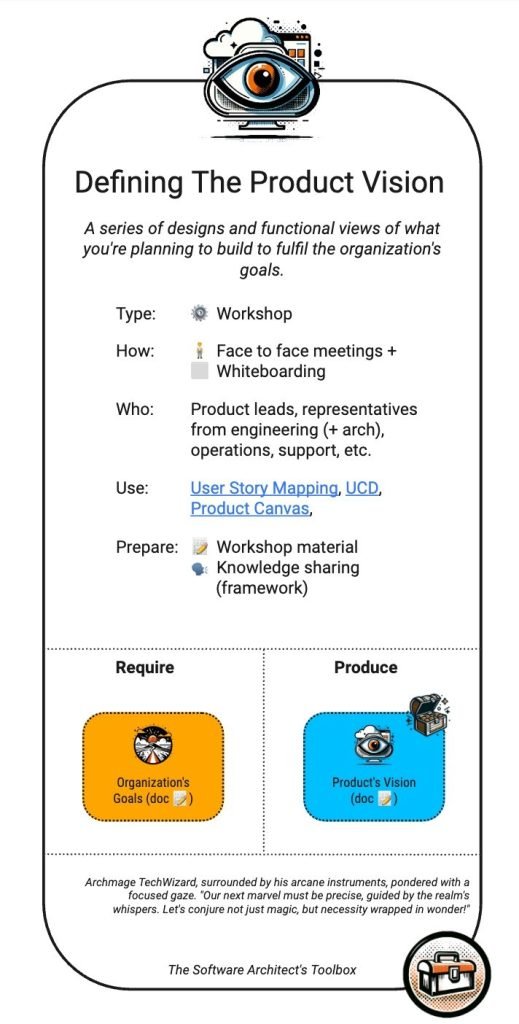
Tool Card: Defining the Product Vision
With organizational goals established, you can define the Product Vision. This card includes links to templates and resources for frameworks you might want to use.
Defining The Product Vision
Tool Card: Defining the Product Vision
Purpose: Translate organizational goals into product strategy
Format: Collaborative workshops with product and business stakeholders
Frameworks to Consider:
Product Vision Board
Lean Canvas
Value Proposition Canvas
Story Mapping
Prerequisites:
Clear organizational goals
Market research
User feedback
Competitive analysis
Outputs:
Product vision statement
Key features and capabilities
User personas
Success criteria
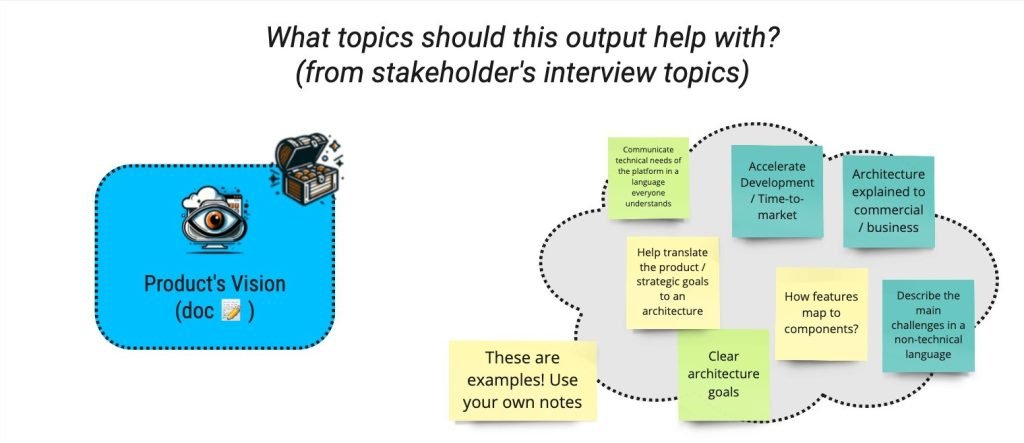
Please don’t forget to map how the output will help your organization:
Mapping the Product Vision outputs to organizational challenges
Mapping tools to challenges
For each tool, map how the output will help your organization address specific challenges:
Unclear priorities → Organizational goals provide focus
Feature creep → Product vision sets boundaries
Technical debt decisions → Goals help prioritize what to fix
The relationship is straightforward but often overlooked:
Organization Goals define what the business wants to achieve
Product Vision translates goals into user value
Technical Architecture enables the product vision
Each level constrains and informs the next. Without clear goals, your product vision is guesswork. Without product vision, your architecture is just technology for its own sake.
Common pitfalls to avoid
Starting with technology
“Let’s use microservices!” before understanding if you need them
Assuming goals are static
Goals evolve; your architecture should be flexible enough to adapt
Confusing activity with progress
Building features doesn’t equal delivering value
Working in isolation
Architecture decisions need business context
Next steps
Oh boy! Your first days navigating software architecture are far from technical (I told you!). So far, you’ve been using tools to interview people and collect documents you can use as input. Or, even more fun and engaging, you’ve had the opportunity to connect with other people and create some documentation (goals, vision) collaboratively to get what you need to move forward.
We’re getting there. One step at a time. These are essential preparations.
In the following article, we’ll cover your task entirely: documenting the current state of the system and its challenges. This critical input will help set the foundations for future decisions. Since the Software Architecture side owns that part, I’ll discuss the frameworks you can use in more detail there.
Key takeaways
Goals first, solutions second - Understand what you’re trying to achieve before how
Product vision bridges business and technology - It translates goals into actionable direction
Use frameworks as guides, not gospel - Adapt them to your context
Collaboration is essential - These exercises work best with diverse perspectives
Documentation creates alignment - Write it down to ensure shared understanding
Remember: Great architecture starts with clear goals. Without them, you’re just building castles in the air.